
The expansion of digital education offers immense promise, but only if every learner can access, use, and benefit from it. True digital transformation is not measured by connectivity alone, but by inclusivity. At NIIT Foundation, this belief shapes every aspect of program design, implementation, and evaluation. NIIT Foundation’s mission is to ensure that digital education in India is accessible, equitable, and dignified, enabling learners of diverse backgrounds and abilities to thrive in a connected world.
Inclusion by Design, Not by Exception
Across India’s education landscape, digital learning opportunities often mirror existing inequalities. Rural students may lack devices and connectivity, learners with disabilities face accessibility barriers, and underrepresented communities may be excluded by content that doesn’t reflect their contexts. NIIT Foundation approaches these challenges proactively—by embedding inclusion right from the design phase of its digital education initiatives.
This involves accessible interfaces, multilingual content, and adaptive learning pathways that allow every learner to progress at their own pace. Rather than treating inclusion as a postscript, NIIT Foundation integrates it as a design principle—ensuring that diversity, equity, and accessibility remain foundational, not peripheral.
Reaching the Last Learner
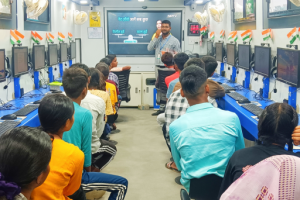
NIIT Foundation’s inclusive education approach is grounded in the principle of reaching the learner where they are. Through partnerships with schools, NGOs, and government departments, NIIT Foundation extends digital access to communities that are often left behind. In remote or resource-poor settings, offline-first digital content and localised learning hubs enable continuity even without constant internet access.
For learners with disabilities, adaptive devices, text-to-speech tools, and assistive software make engagement seamless. Teachers and trainers are sensitised to create accessible classrooms that emphasize participation rather than compliance.
A Holistic Inclusion Framework
Inclusivity in digital education goes beyond physical access—it also requires building digital confidence and cultural relevance. NIIT Foundation’s curricula incorporate content that reflects learners’ lived realities and promote gender equity in digital participation. Special initiatives encourage girls to pursue technology-enabled learning and career pathways, narrowing gender divides in digital literacy.
One such initiative is the Career Development Program, where NIIT Foundation set up (Career Development Centers) in Salem (Tamil Nadu), Tumkur (Karnataka), Nagpur (Maharashtra) and Mahbubnagar (Telangana). These centers managed to exceed estimated targets, with a total of 1307 enrolled students for a target of 1200, 1291 completions for a target of 1100 and 636 placements for a target of 540. 68% of placed students continued working beyond the first month, indicating job stability.
The CDCs target underserved communities and raise employable skills and knowledge. Community support and post-placement tracking ensures support for these women and girls throughout the program, aiming to improve their living standards, career prospects, livelihood opportunities, and overall community development.
Data-Driven Impact and Scaling Up
To ensure accountability and long-term success, inclusion outcomes are tracked through data dashboards and impact evaluations. These insights help refine learning experiences to align with the evolving needs of diverse learner groups. Continuous feedback loops between trainers, students, and implementation teams ensure that inclusion remains dynamic and adaptive.
Shaping an Equitable Digital Future
The future of education is digital, but it must also be just. NIIT Foundation’s inclusive approach reaffirms that digitalisation, when guided by empathy and design thinking, can democratise opportunity. By ensuring that no learner is left behind, NIIT Foundation not only nurtures digital competence but also upholds the dignity of education itself.
Inclusive digital education is not simply about access to technology, it is about access to opportunity, agency, and aspiration. Through its ongoing initiatives, NIIT Foundation continues to prove that digital inclusion is not a challenge to overcome, but a promise to fulfill.