Across India, millions still remain digitally disconnected despite the country’s rapid shift toward a technology-enabled economy. According to the World Bank, nearly half of rural households in developing nations lack meaningful access to digital tools, creating deep divides in education and economic participation. For communities living in remote villages, forest belts, hilly terrains, and underserved settlements, even turning on a computer or accessing online information remains unfamiliar. NIIT Foundation’s Digital Bus initiative bridges this critical gap by taking learning directly to where it is needed most.
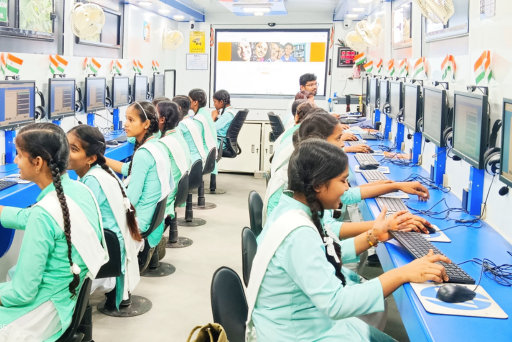
Each Digital Bus functions as a mobile education ecosystem, equipped with computers, internet connectivity, and trained facilitators who deliver structured digital literacy and foundational skills. By covering [number] districts and travelling across India’s hardest-to-reach locations, the initiative ensures that opportunity is not confined to urban centres but is mobile, inclusive, and community-driven.
A Mobile Classroom Bringing First-Time Learners into the Digital World
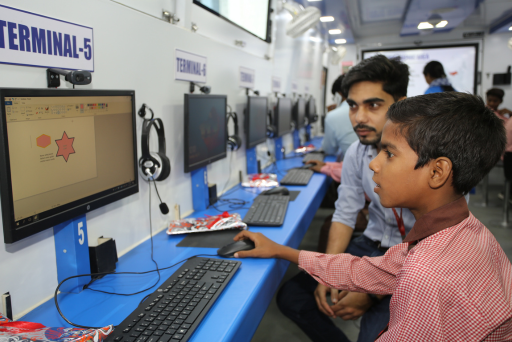
Stepping into the Digital Bus is, for many learners, their first-ever interaction with technology. The interior is designed as a fully functional classroom, complete with digital devices, instructional screens, and interactive learning modules. Facilitators introduce learners to the basics of using a mouse, typing, navigating digital interfaces, browsing the Internet, and engaging with online tools that support education, information access, and livelihoods.
The International Telecommunication Union (ITU) notes that first-time users require sustained handholding to build confidence and reduce fear of technology, which is why guided learning inside the Digital Bus becomes essential. Facilitators not only teach technical skills but also help participants overcome hesitation, making digital literacy an empowering, emotionally transformative experience.
Because the bus travels directly into villages, hamlets, and semi-urban pockets where infrastructure for learning is limited or absent, the initiative ensures that geography does not become a barrier. From tribal communities to agrarian households and migrant settlements, the Digital Bus arrives at the doorstep of those who would otherwise remain excluded from digital participation.
Driving Digital Inclusion in Line with India’s National Priorities
As government services, healthcare systems, education platforms, and financial services increasingly move online, digital literacy becomes the backbone of economic and social empowerment. UNESCO’s Global Education Monitoring Report highlights that digital inclusion is directly linked to improved learning outcomes and enhanced access to livelihood pathways. The Digital Bus initiative advances this vision by equipping learners with skills that enable them to engage meaningfully with the digital ecosystem.
Participants learn to access government portals, use digital payments safely, browse educational content, and explore skill-development resources that can support employment or entrepreneurship. The program places a strong focus on women and youth—groups often disproportionately affected by digital exclusion—by offering a safe, supportive, community-based environment.
As confidence grows, the impact becomes visible. A student uses online videos to supplement school learning. A shopkeeper begins using digital payments. A homemaker accesses telehealth resources or online skilling platforms. Each learner becomes a link in a wider chain of inclusion, gradually strengthening the digital fabric of the entire community.
Innovation on Wheels: A Scalable Model for Equitable Growth
The Digital Bus is a practical demonstration of how innovation can advance social equity. Instead of waiting for digital infrastructure to reach remote areas, NIIT Foundation brings the infrastructure to them. This approach aligns with national priorities under the Digital India mission, while also echoing global calls for closing the digital divide.
Over time, the bus becomes a familiar and trusted presence. Children gather with excitement when it arrives. Parents adjust their routines to attend classes. Communities begin to see technology not as a distant concept but as a tool that can improve their lives. With each kilometre it travels across numerous places the Digital Bus adds new learners, new aspirations, and new stories of empowerment.
In an increasingly digital world, equitable access to opportunity is non-negotiable. NIIT Foundation’s Digital Bus stands at the intersection of education, innovation, and social transformation. It ensures that India’s digital progress is not uneven but shared—and that every learner, irrespective of their location, can take confident steps toward a better future.