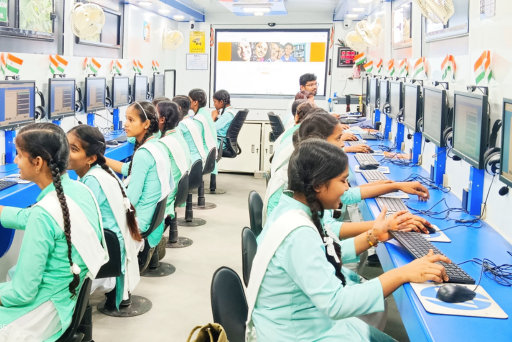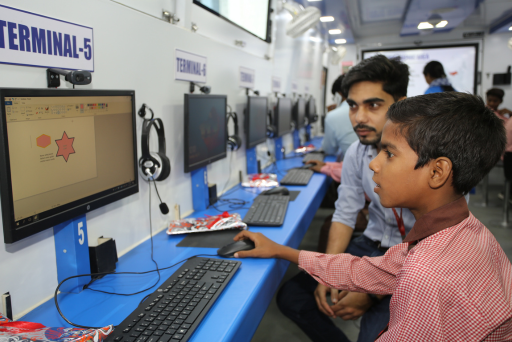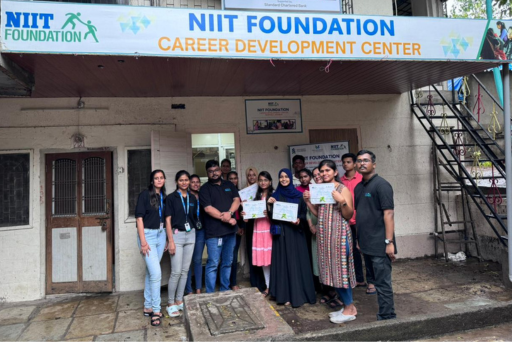
Access to skilling is often discussed in terms of building more centres, improving connectivity, or expanding course offerings. While these remain important, they do not fully address a persistent challenge. For many young people in underserved communities, the barrier is not willingness to learn but proximity. Distance from training centres, cost of travel, and competing family responsibilities often make regular participation difficult.
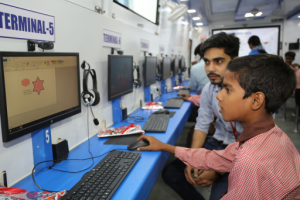
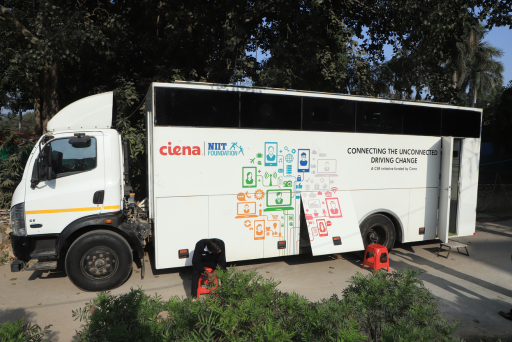
It is in response to this reality that NIIT Foundation launched its Digital Bus initiative, a mobile learning program designed to take skilling and employability training directly to communities that are otherwise difficult to reach. By converting buses into fully equipped digital classrooms, the initiative brings structured learning environments to urban settlements, peri-urban areas, and remote locations.
As of the current reporting period, the Digital Bus is operational across 13 states and 139 districts, with 17 Digital Buses delivering skilling and employability programs on the ground. The initiative has reached an estimated 5.64 lakh learners, focusing on youth from underserved communities, including urban slum populations, women learners, and first-generation digital users. For many participants, this is their first sustained interaction with computers, digital platforms, and structured technology-enabled learning.
Global institutions increasingly recognise the importance of such last-mile delivery models. The World Bank has noted that proximity and contextual delivery are critical to improving participation in skilling programs, particularly among marginalised youth and first-generation learners.
Overcoming the Fear of the Unknown Through AI-Supported Learning
For learners entering the Digital Bus classrooms, technology often feels unfamiliar. This unfamiliarity can easily turn into fear. Not fear of failure, but fear of what technology is, what it can do, and how one is expected to interact with it. Artificial intelligence, in particular, is frequently perceived as complex or abstract.
Within the Digital Bus program, this fear is addressed through gradual exposure and guided exploration. Trainers begin by explaining what digital tools and AI are, using everyday examples and simple language. Learners are encouraged to explore systems without worrying about “breaking” anything or asking the wrong question.
AI-supported tools are introduced as learning aids rather than evaluative systems. Learners engage with adaptive quizzes that adjust to their pace. They receive automated feedback that allows repeated practice without embarrassment. AI-enabled tutors explain concepts patiently, enabling learners to revisit topics until they feel confident.
A core part of this process is helping learners understand how to communicate with technology. Trainers guide them in framing questions, refining prompts, and observing how better inputs lead to better outputs. Learners discover that effective use of AI depends more on clarity of thought than technical sophistication.
This approach aligns with findings from the UNESCO, which emphasises that digital inclusion requires building confidence and agency alongside skills. When learners feel safe experimenting, technology becomes an enabler rather than a barrier.
Using Technology to Support Persistence and Inclusion
Beyond classroom learning, the Digital Bus initiative is supported by LMS-enabled tracking systems that help identify learners who may be at risk of disengaging. Patterns such as irregular attendance or declining participation act as early indicators rather than final judgments.
When such signals emerge, trainers and counsellors intervene proactively. Conversations focus on understanding barriers, whether related to family responsibilities, financial stress, or learning difficulties. Support may include academic guidance, counselling sessions, or adjustments to learning schedules.
This use of technology reflects global good practice. The International Labour Organization has highlighted the importance of early intervention mechanisms in preventing dropouts from skilling programs, particularly among vulnerable groups.
The mobility of the Digital Bus further strengthens inclusion. By delivering training within communities, the program reduces opportunity costs for women learners, caregivers, and individuals engaged in informal or irregular work, contributing to improved participation and retention outcomes.
Building Confidence for a Changing World of Work
The impact of the Digital Bus initiative extends beyond skill acquisition. Learners who once hesitated to interact with technology begin experimenting independently. Many practise professional communication, basic digital tasks, or employability skills using AI-supported tools within the program.
As unfamiliarity fades, curiosity grows. Learners start seeing technology as something that can support their aspirations rather than limit them. This confidence is critical in a labour market shaped by digital services, AI-assisted roles, and continuous reskilling.
By integrating mobility, hybrid learning, and AI-supported pedagogy, NIIT Foundation’s Digital Bus demonstrates how technology can act as a true equaliser. It shows that when digital tools are delivered with empathy, context, and human guidance, they can expand access to careers while preserving dignity and inclusion.